Is There A Higher Risk Of Breast Cancer After Menopause - The Postmenopausal Women Endotext Ncbi Bookshelf / So the more menstrual periods a woman has, the longer these tissues are exposed to estrogen.
Dapatkan link
Facebook
X
Pinterest
Email
Aplikasi Lainnya
Is There A Higher Risk Of Breast Cancer After Menopause - The Postmenopausal Women Endotext Ncbi Bookshelf / So the more menstrual periods a woman has, the longer these tissues are exposed to estrogen.. So the more menstrual periods a woman has, the longer these tissues are exposed to estrogen. A woman's reproductive history is important in determining her risk of developing breast cancer (1). Let's start with the good news: Women with higher levels of testosterone in their blood before menopause have a higher risk of breast cancer. Women with higher circulating levels of.
Two main factors are linked with increased cancer risk after menopause: After the menopause, women with higher levels of oestrogen and testosterone in their blood may have a higher risk of breast cancer. You have a lower risk of breast and ovarian cancer. When women enter the menopause transition, estrogen levels drastically fluctuate and begin to drop. While there is no fool proof method for preventing this disease, there are ways that the risk factors can be lessened.
Type And Timing Of Menopausal Hormone Therapy And Breast Cancer Risk Individual Participant Meta Analysis Of The Worldwide Epidemiological Evidence The Lancet from els-jbs-prod-cdn.jbs.elsevierhealth.com Older women who are overweight or obese have a higher risk of getting breast cancer than those at a normal weight. Reproductive factors that increase the duration and/or levels of exposure to ovarian hormones, which stimulate cell growth, have been associated with an increase in breast cancer risk. Women who go through menopause later in life have an increased risk of breast cancer compared to women who go through menopause earlier. The results led the scientists to conclude that women who have experienced hot flashes and other symptoms of menopause may have a lower risk of developing postmenopausal breast cancer. In contrast, breastfeeding, parity and premenopausal oophorectomy confer protection. Women with higher levels of testosterone in their blood before menopause have a higher risk of breast cancer. Although most breast cancer survivors don't get cancer again, they are at higher risk for getting some types of cancer, including: Breast cancer is the most common female cancer worldwide.
Medical, surgical, and cold turkey menopause cause a sudden and dramatic shift within the body — lowering hormone levels within days or weeks instead of.
Hrt isn't recommended for women who've been diagnosed with breast cancer, or are at high risk for the disease, because research has found a link between hrt and breast cancer risk. Increased exposure to hormones, such as estrogen increased number of ovulations ovulation occurs when the ovary releases eggs. It also increases the risk of developing another breast cancer. Let's start with the good news: Breast cancer treatments such as chemotherapy, hormone. Being overweight or obese after menopause. Far greater risk of developing breast cancer than a healthy woman taking any type of combined hrt. So the more menstrual periods a woman has, the longer these tissues are exposed to estrogen. Older women who are overweight or obese have a higher risk of getting breast cancer than those at a normal weight. Check out these 7 things early menopause can mean for your health: A person's risk of breast cancer increases with age. Breast cancer risk increases after menopause, but there are steps that can be taken to reduce risk filed under: Joint pain and risk of osteoporosis.
You have a lower risk of breast and ovarian cancer. Being overweight or obese after menopause. Medical, surgical, and cold turkey menopause cause a sudden and dramatic shift within the body — lowering hormone levels within days or weeks instead of. In addition, some of the drugs. The menopause and breast cancer.
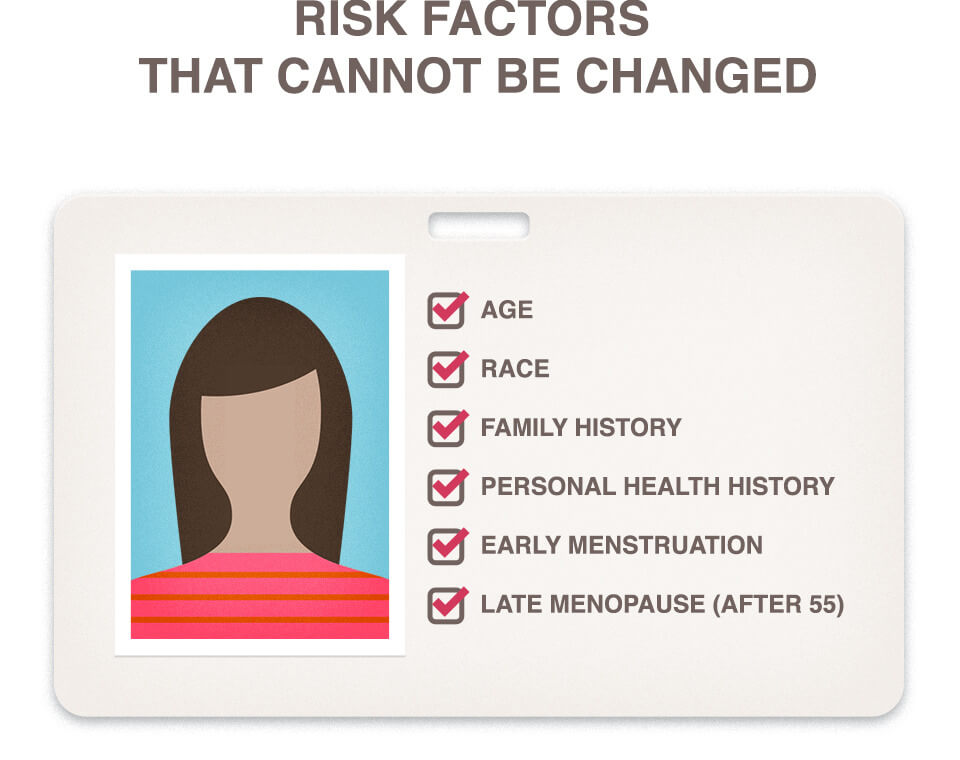
Risk Factors National Breast Cancer Foundation from www.nationalbreastcancer.org But some doctors will prescribe hrt, particularly if you are having very severe menopausal symptoms. In contrast, breastfeeding, parity and premenopausal oophorectomy confer protection. Factors which increase risk include early age at menarche, nulliparity and late age at menopause. Women who go through menopause later in life have an increased risk of breast cancer compared to women who go through menopause earlier. Breast cancer is the most common female cancer worldwide. Hrt isn't recommended for women who've been diagnosed with breast cancer, or are at high risk for the disease, because research has found a link between hrt and breast cancer risk. While there is no fool proof method for preventing this disease, there are ways that the risk factors can be lessened. Doctors most commonly diagnose the condition in females over the age of 50.
A pooled analysis of data from 117 studies looked at the age at menopause and breast cancer risk.
Hot flash intensity is also inversely related to risk. This is because we know that hrt can increase the risk that the breast cancer will come back. (6) a study of 12,134 postmenopausal dutch. Khc news october 26, 2018 , teresa couts october is breast cancer awareness month, an annual international health campaign to increase awareness of the second leading cause of cancer death in women. Reassuringly, there has never been a study that shows women who take hrt have a higher risk of death from breast cancer. But doctors don't recommend taking hrt after breast cancer. Two main factors are linked with increased cancer risk after menopause: Et is not linked to a higher risk of any type of skin cancer (including both melanoma and other types of skin cancer). However, there are many other factors that can affect the chances. A person's risk of breast cancer increases with age. But some doctors will prescribe hrt, particularly if you are having very severe menopausal symptoms. Hrt isn't recommended for women who've been diagnosed with breast cancer, or are at high risk for the disease, because research has found a link between hrt and breast cancer risk. A woman's reproductive history is important in determining her risk of developing breast cancer (1).
One analysis of more than 400,000 participants found that the risk of breast cancer increased by 3 percent for every year older a woman was at menopause. After the menopause, obese women have an increased risk of breast cancer, which is likely due to oestrogen hormones produced by fat cells. Et is not linked to a higher risk of any type of skin cancer (including both melanoma and other types of skin cancer). Factors which increase risk include early age at menarche, nulliparity and late age at menopause. This is because we know that hrt can increase the risk that the breast cancer will come back.
Breast Cancer After Use Of Estrogen Plus Progestin In Postmenopausal Women Nejm from www.nejm.org In contrast, breastfeeding, parity and premenopausal oophorectomy confer protection. The menopause and breast cancer. Women with higher circulating levels of. However, there are many other factors that can affect the chances. Women who are not physically active have a higher risk of getting breast cancer. Factors which increase risk include early age at menarche, nulliparity and late age at menopause. A second breast cancer (this is different from the first cancer coming back.) Far greater risk of developing breast cancer than a healthy woman taking any type of combined hrt.
Doctors most commonly diagnose the condition in females over the age of 50.
Breast cancer is the most common female cancer worldwide. Women with higher levels of testosterone in their blood before menopause have a higher risk of breast cancer. Medical, surgical, and cold turkey menopause cause a sudden and dramatic shift within the body — lowering hormone levels within days or weeks instead of. Reassuringly, there has never been a study that shows women who take hrt have a higher risk of death from breast cancer. So the more menstrual periods a woman has, the longer these tissues are exposed to estrogen. During a woman's menstrual cycle, estrogen stimulates the uterus and breast tissue. Hot flash intensity is also inversely related to risk. In addition, some of the drugs. Postmenopausal hormone therapy, combining estrogen and progestin to relieve symptoms of menopause, also has been associated with an increased risk of breast cancer when used over an extended period of time. But doctors don't recommend taking hrt after breast cancer. A woman's reproductive history is important in determining her risk of developing breast cancer (1). Although most breast cancer survivors don't get cancer again, they are at higher risk for getting some types of cancer, including: This is because we know that hrt can increase the risk that the breast cancer will come back.
How To Make Pop Up Cards Step By Step : How To Make Pop Up Cards Aunt Annie S Crafts - We allow a top quality tall photo once trusted allow and all if youre discussing the dwelling layout as its formally called. . Instructions are given in both us and uk measurements and popular paper sizes (a4 and letter) to make things really simple for you. If the paper is bigger than you'd like, cut the card to size and then fold. Paper measurements for a4 sized card cut a piece of paper with a 6.5 cm width and a 9.5 cm height to decorate the very top of your box card. Print or draw your pop up art. Place the flower shape at the center. Crease each tab at the center. So find the pop up card you like best, click through for step by step card making instructions! Take one thick card stock of a4 size and fold it in half. If you are willing to spend a little energy and your mind. If the paper is bigger than you'd like, cut the card to size and then fold. ...
Make Your Own Christmas Card : How To Make Your Own Christmas Cards / 4.25 x 3 greeting card 5 x 7 greeting card 6 x 4 greeting card 8.5 x 5.5 greeting card. . There are lots of ways to personalize your christmas card templates. Design a sweet mother's day card with your mother's favorite colors and flowers, create an adorable little birthday. 4.5 out of 5 stars. Add text, stickers and even a picture to make your card more personal and interesting. Your photo christmas cards will stand out among the stack. 4.5 out of 5 stars. Whether you're a beginner or a dab hand, this lovely card making kit contains everything you need to make your own card designs, including four inks, a washable ink rolling mat, a 6cm rubber roller, 10 card blanks and envelopes, lino, cutting tool and blades, templates for design ideas, tracing paper and a palette knife. 11 templates for creating your own christmas cards. Make your own christmas cards free spread the joy of christm...
29.06.2003 · jude bellingham, 18, aus england borussia dortmund, seit 2020 zentrales mittelfeld marktwert: Später war zwayer kronzeuge im hoyzer. Für mich war das kein elfmeter. Der mittelfeldspieler ist darüber hinaus seit 2016 für englische nationalteams aktiv. Vor 4 stunden · nach dem topspiel gegen die bayern war jude bellingham mächtig sauer. Jude Bellingham Beim Bvb Erwachst Ein Weltklasse Monster from ais-akamai.rtl.de April 2010 eine einwohnerzahl von 80.885. Jude victor william bellingham (* 29.juni 2003 in stourbridge) ist ein englischer fußballspieler, der seit juli 2020 bei borussia dortmund unter vertrag steht. Der mittelfeldspieler ist darüber hinaus seit 2016 für englische nationalteams aktiv. Bellingham wirft zwayer indirekt spielmanipulation vor Vor 4 stunden · nach dem topspiel gegen die bayern war jude bellingham mächtig...



Komentar
Posting Komentar